The Tunnel
Under
The World
By FREDERIK POHL
Illustrated by EMSH
Pinching yourself is no way to see if you are dreaming. Surgical instruments? Well, yes—but a mechanic's kit is best of all!
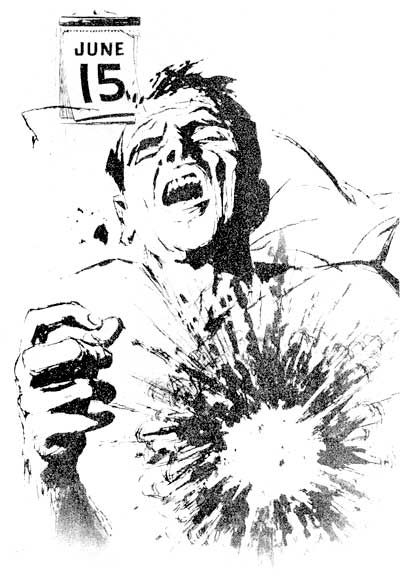
n the morning of June 15th, Guy Burckhardt woke up screaming out of a dream.
It was more real than any dream he had ever had in his life. He could still hear and feel the sharp, ripping-metal explosion, the violent heave that had tossed him furiously out of bed, the searing wave of heat.
He sat up convulsively and stared, not believing what he saw, at the quiet room and the bright sunlight coming in the window.
He croaked, "Mary?"
His wife was not in the bed next to him. The covers were tumbled and awry, as though she had just left it, and the memory of the dream was so strong that instinctively he found himself searching the floor to see if the dream explosion had thrown her down.
But she wasn't there. Of course she wasn't, he told himself, looking at the familiar vanity and slipper chair, the uncracked window, the unbuckled wall. It had only been a dream.
"Guy?" His wife was calling him querulously from the foot of the stairs. "Guy, dear, are you all right?"
He called weakly, "Sure."
There was a pause. Then Mary said doubtfully, "Breakfast is ready. Are you sure you're all right? I thought I heard you yelling—"
Burckhardt said more confidently, "I had a bad dream, honey. Be right down."
n the shower, punching the lukewarm-and-cologne he favored, he told himself that it had been a beaut of a dream. Still, bad dreams weren't unusual, especially bad dreams about explosions. In the past thirty years of H-bomb jitters, who had not dreamed of explosions?
Even Mary had dreamed of them, it turned out, for he started to tell her about the dream, but she cut him off. "You did?" Her voice was astonished. "Why, dear, I dreamed the same thing! Well, almost the same thing. I didn't actually hear anything. I dreamed that something woke me up, and then there was a sort of quick bang, and then something hit me on the head. And that was all. Was yours like that?"
Burckhardt coughed. "Well, no," he said. Mary was not one of these strong-as-a-man, brave-as-a-tiger women. It was not necessary, he thought, to tell her all the little details of the dream that made it seem so real. No need to mention the splintered ribs, and the salt bubble in his throat, and the agonized knowledge that this was death. He said, "Maybe there really was some kind of explosion downtown. Maybe we heard it and it started us dreaming."
Mary reached over and patted his hand absently. "Maybe," she agreed. "It's almost half-past eight, dear. Shouldn't you hurry? You don't want to be late to the office."
He gulped his food, kissed her and rushed out—not so much to be on time as to see if his guess had been right.
But downtown Tylerton looked as it always had. Coming in on the bus, Burckhardt watched critically out the window, seeking evidence of an explosion. There wasn't any. If anything, Tylerton looked better than it ever had before: It was a beautiful crisp day, the sky was cloudless, the buildings were clean and inviting. They had, he observed, steam-blasted the Power & Light Building, the town's only skyscraper—that was the penalty of having Contro Chemical's main plant on the outskirts of town; the fumes from the cascade stills left their mark on stone buildings.
None of the usual crowd were on the bus, so there wasn't anyone Burckhardt could ask about the explosion. And by the time he got out at the corner of Fifth and Lehigh and the bus rolled away with a muted diesel moan, he had pretty well convinced himself that it was all imagination.
He stopped at the cigar stand in the lobby of his office building, but Ralph wasn't behind the counter. The man who sold him his pack of cigarettes was a stranger.
"Where's Mr. Stebbins?" Burckhardt asked.
The man said politely, "Sick, sir. He'll be in tomorrow. A pack of Marlins today?"
"Chesterfields," Burckhardt corrected.
"Certainly, sir," the man said. But what he took from the rack and slid across the counter was an unfamiliar green-and-yellow pack.
"Do try these, sir," he suggested. "They contain an anti-cough factor. Ever notice how ordinary cigarettes make you choke every once in a while?"
urckhardt said suspiciously, "I never heard of this brand."
"Of course not. They're something new." Burckhardt hesitated, and the man said persuasively, "Look, try them out at my risk. If you don't like them, bring back the empty pack and I'll refund your money. Fair enough?"
Burckhardt shrugged. "How can I lose? But give me a pack of Chesterfields, too, will you?"
He opened the pack and lit one while he waited for the elevator. They weren't bad, he decided, though he was suspicious of cigarettes that had the tobacco chemically treated in any way. But he didn't think much of Ralph's stand-in; it would raise hell with the trade at the cigar stand if the man tried to give every customer the same high-pressure sales talk.
The elevator door opened with a low-pitched sound of music. Burckhardt and two or three others got in and he nodded to them as the door closed. The thread of music switched off and the speaker in the ceiling of the cab began its usual commercials.
No, not the usual commercials, Burckhardt realized. He had been exposed to the captive-audience commercials so long that they hardly registered on the outer ear any more, but what was coming from the recorded program in the basement of the building caught his attention. It wasn't merely that the brands were mostly unfamiliar; it was a difference in pattern.
There were jingles with an insistent, bouncy rhythm, about soft drinks he had never tasted. There was a rapid patter dialogue between what sounded like two ten-year-old boys about a candy bar, followed by an authoritative bass rumble: "Go right out and get a DELICIOUS Choco-Bite and eat your TANGY Choco-Bite all up. That's Choco-Bite!" There was a sobbing female whine: "I wish I had a Feckle Freezer! I'd do anything for a Feckle Freezer!" Burckhardt reached his floor and left the elevator in the middle of the last one. It left him a little uneasy. The commercials were not for familiar brands; there was no feeling of use and custom to them.
But the office was happily normal—except that Mr. Barth wasn't in. Miss Mitkin, yawning at the reception desk, didn't know exactly why. "His home phoned, that's all. He'll be in tomorrow."
"Maybe he went to the plant. It's right near his house."
She looked indifferent. "Yeah."
A thought struck Burckhardt. "But today is June 15th! It's quarterly tax return day—he has to sign the return!"
Miss Mitkin shrugged to indicate that that was Burckhardt's problem, not hers. She returned to her nails.
Thoroughly exasperated, Burckhardt went to his desk. It wasn't that he couldn't sign the tax returns as well as Barth, he thought resentfully. It simply wasn't his job, that was all; it was a responsibility that Barth, as office manager for Contro Chemicals' downtown office, should have taken.
e thought briefly of calling Barth at his home or trying to reach him at the factory, but he gave up the idea quickly enough. He didn't really care much for the people at the factory and the less contact he had with them, the better. He had been to the factory once, with Barth; it had been a confusing and, in a way, a frightening experience. Barring a handful of executives and engineers, there wasn't a soul in the factory—that is, Burckhardt corrected himself, remembering what Barth had told him, not a living soul—just the machines.
According to Barth, each machine was controlled by a sort of computer which reproduced, in its electronic snarl, the actual memory and mind of a human being. It was an unpleasant thought. Barth, laughing, had assured him that there was no Frankenstein business of robbing graveyards and implanting brains in machines. It was only a matter, he said, of transferring a man's habit patterns from brain cells to vacuum-tube cells. It didn't hurt the man and it didn't make the machine into a monster.
But they made Burckhardt uncomfortable all the same.
He put Barth and the factory and all his other little irritations out of his mind and tackled the tax returns. It took him until noon to verify the figures—which Barth could have done out of his memory and his private ledger in ten minutes, Burckhardt resentfully reminded himself.
He sealed them in an envelope and walked out to Miss Mitkin. "Since Mr. Barth isn't here, we'd better go to lunch in shifts," he said. "You can go first."
"Thanks." Miss Mitkin languidly took her bag out of the desk drawer and began to apply makeup.
Burckhardt offered her the envelope. "Drop this in the mail for me, will you? Uh—wait a minute. I wonder if I ought to phone Mr. Barth to make sure. Did his wife say whether he was able to take phone calls?"
"Didn't say." Miss Mitkin blotted her lips carefully with a Kleenex. "Wasn't his wife, anyway. It was his daughter who called and left the message."
"The kid?" Burckhardt frowned. "I thought she was away at school."
"She called, that's all I know."
Burckhardt went back to his own office and stared distastefully at the unopened mail on his desk. He didn't like nightmares; they spoiled his whole day. He should have stayed in bed, like Barth.
funny thing happened on his way home. There was a disturbance at the corner where he usually caught his bus—someone was screaming something about a new kind of deep-freeze—so he walked an extra block. He saw the bus coming and started to trot. But behind him, someone was calling his name. He looked over his shoulder; a small harried-looking man was hurrying toward him.
Burckhardt hesitated, and then recognized him. It was a casual acquaintance named Swanson. Burckhardt sourly observed that he had already missed the bus.
He said, "Hello."
Swanson's face was desperately eager. "Burckhardt?" he asked inquiringly, with an odd intensity. And then he just stood there silently, watching Burckhardt's face, with a burning eagerness that dwindled to a faint hope and died to a regret. He was searching for something, waiting for something, Burckhardt thought. But whatever it was he wanted, Burckhardt didn't know how to supply it.
Burckhardt coughed and said again, "Hello, Swanson."
Swanson didn't even acknowledge the greeting. He merely sighed a very deep sigh.
"Nothing doing," he mumbled, apparently to himself. He nodded abstractedly to Burckhardt and turned away.
Burckhardt watched the slumped shoulders disappear in the crowd. It was an odd sort of day, he thought, and one he didn't much like. Things weren't going right.
Riding home on the next bus, he brooded about it. It wasn't anything terrible or disastrous; it was something out of his experience entirely. You live your life, like any man, and you form a network of impressions and reactions. You expect things. When you open your medicine chest, your razor is expected to be on the second shelf; when you lock your front door, you expect to have to give it a slight extra tug to make it latch.
It isn't the things that are right and perfect in your life that make it familiar. It is the things that are just a little bit wrong—the sticking latch, the light switch at the head of the stairs that needs an extra push because the spring is old and weak, the rug that unfailingly skids underfoot.
It wasn't just that things were wrong with the pattern of Burckhardt's life; it was that the wrong things were wrong. For instance, Barth hadn't come into the office, yet Barth always came in.
Burckhardt brooded about it through dinner. He brooded about it, despite his wife's attempt to interest him in a game of bridge with the neighbors, all through the evening. The neighbors were people he liked—Anne and Farley Dennerman. He had known them all their lives. But they were odd and brooding, too, this night and he barely listened to Dennerman's complaints about not being able to get good phone service or his wife's comments on the disgusting variety of television commercials they had these days.
Burckhardt was well on the way to setting an all-time record for continuous abstraction when, around midnight, with a suddenness that surprised him—he was strangely aware of it happening—he turned over in his bed and, quickly and completely, fell asleep.
II
n the morning of June 15th, Burckhardt woke up screaming.
It was more real than any dream he had ever had in his life. He could still hear the explosion, feel the blast that crushed him against a wall. It did not seem right that he should be sitting bolt upright in bed in an undisturbed room.
His wife came pattering up the stairs. "Darling!" she cried. "What's the matter?"
He mumbled, "Nothing. Bad dream."
She relaxed, hand on heart. In an angry tone, she started to say: "You gave me such a shock—"
But a noise from outside interrupted her. There was a wail of sirens and a clang of bells; it was loud and shocking.
The Burckhardts stared at each other for a heartbeat, then hurried fearfully to the window.
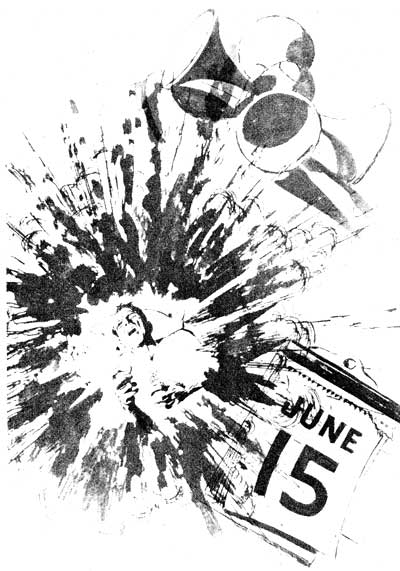
There were no rumbling fire engines in the street, only a small panel truck, cruising slowly along. Flaring loudspeaker horns crowned its top. From them issued the screaming sound of sirens, growing in intensity, mixed with the rumble of heavy-duty engines and the sound of bells. It was a perfect record of fire engines arriving at a four-alarm blaze.
Burckhardt said in amazement, "Mary, that's against the law! Do you know what they're doing? They're playing records of a fire. What are they up to?"
"Maybe it's a practical joke," his wife offered.
"Joke? Waking up the whole neighborhood at six o'clock in the morning?" He shook his head. "The police will be here in ten minutes," he predicted. "Wait and see."
But the police weren't—not in ten minutes, or at all. Whoever the pranksters in the car were, they apparently had a police permit for their games.
The car took a position in the middle of the block and stood silent for a few minutes. Then there was a crackle from the speaker, and a giant voice chanted:
"Feckle Freezers!Feckle Freezers!Gotta have aFeckle Freezer!Feckle, Feckle, Feckle,Feckle, Feckle, Feckle—"
It went on and on. Every house on the block had faces staring out of windows by then. The voice was not merely loud; it was nearly deafening.
Burckhardt shouted to his wife, over the uproar, "What the hell is a Feckle Freezer?"
"Some kind of a freezer, I guess, dear," she shrieked back unhelpfully.
bruptly the noise stopped and the truck stood silent. It was still misty morning; the Sun's rays came horizontally across the rooftops. It was impossible to believe that, a moment ago, the silent block had been bellowing the name of a freezer.
"A crazy advertising trick," Burckhardt said bitterly. He yawned and turned away from the window. "Might as well get dressed. I guess that's the end of—"
The bellow caught him from behind; it was almost like a hard slap on the ears. A harsh, sneering voice, louder than the arch-angel's trumpet, howled:
"Have you got a freezer? It stinks! If it isn't a Feckle Freezer, it stinks! If it's a last year's Feckle Freezer, it stinks! Only this year's Feckle Freezer is any good at all! You know who owns an Ajax Freezer? Fairies own Ajax Freezers! You know who owns a Triplecold Freezer? Commies own Triplecold Freezers! Every freezer but a brand-new Feckle Freezer stinks!"
The voice screamed inarticulately with rage. "I'm warning you! Get out and buy a Feckle Freezer right away! Hurry up! Hurry for Feckle! Hurry for Feckle! Hurry, hurry, hurry, Feckle, Feckle, Feckle, Feckle, Feckle, Feckle...."
It stopped eventually. Burckhardt licked his lips. He started to say to his wife, "Maybe we ought to call the police about—" when the speakers erupted again. It caught him off guard; it was intended to catch him off guard. It screamed:
"Feckle, Feckle, Feckle, Feckle, Feckle, Feckle, Feckle, Feckle. Cheap freezers ruin your food. You'll get sick and throw up. You'll get sick and die. Buy a Feckle, Feckle, Feckle, Feckle! Ever take a piece of meat out of the freezer you've got and see how rotten and moldy it is? Buy a Feckle, Feckle, Feckle, Feckle, Feckle. Do you want to eat rotten, stinking food? Or do you want to wise up and buy a Feckle, Feckle, Feckle—"
That did it. With fingers that kept stabbing the wrong holes, Burckhardt finally managed to dial the local police station. He got a busy signal—it was apparent that he was not the only one with the same idea—and while he was shakingly dialing again, the noise outside stopped.
He looked out the window. The truck was gone.
urckhardt loosened his tie and ordered another Frosty-Flip from the waiter. If only they wouldn't keep the Crystal Cafe so hot! The new paint job—searing reds and blinding yellows—was bad enough, but someone seemed to have the delusion that this was January instead of June; the place was a good ten degrees warmer than outside.
He swallowed the Frosty-Flip in two gulps. It had a kind of peculiar flavor, he thought, but not bad. It certainly cooled you off, just as the waiter had promised. He reminded himself to pick up a carton of them on the way home; Mary might like them. She was always interested in something new.
He stood up awkwardly as the girl came across the restaurant toward him. She was the most beautiful thing he had ever seen in Tylerton. Chin-height, honey-blonde hair and a figure that—well, it was all hers. There was no doubt in the world that the dress that clung to her was the only thing she wore. He felt as if he were blushing as she greeted him.
"Mr. Burckhardt." The voice was like distant tomtoms. "It's wonderful of you to let me see you, after this morning."
He cleared his throat. "Not at all. Won't you sit down, Miss—"
"April Horn," she murmured, sitting down—beside him, not where he had pointed on the other side of the table. "Call me April, won't you?"
She was wearing some kind of perfume, Burckhardt noted with what little of his mind was functioning at all. It didn't seem fair that she should be using perfume as well as everything else. He came to with a start and realized that the waiter was leaving with an order for filets mignon for two.
"Hey!" he objected.
"Please, Mr. Burckhardt." Her shoulder was against his, her face was turned to him, her breath was warm, her expression was tender and solicitous. "This is all on the Feckle Corporation. Please let them—it's the least they can do."
He felt her hand burrowing into his pocket.
"I put the price of the meal into your pocket," she whispered conspiratorially. "Please do that for me, won't you? I mean I'd appreciate it if you'd pay the waiter—I'm old-fashioned about things like that."
She smiled meltingly, then became mock-businesslike. "But you must take the money," she insisted. "Why, you're letting Feckle off lightly if you do! You could sue them for every nickel they've got, disturbing your sleep like that."
ith a dizzy feeling, as though he had just seen someone make a rabbit disappear into a top hat, he said, "Why, it really wasn't so bad, uh, April. A little noisy, maybe, but—"
"Oh, Mr. Burckhardt!" The blue eyes were wide and admiring. "I knew you'd understand. It's just that—well, it's such a wonderful freezer that some of the outside men get carried away, so to speak. As soon as the main office found out about what happened, they sent representatives around to every house on the block to apologize. Your wife told us where we could phone you—and I'm so very pleased that you were willing to let me have lunch with you, so that I could apologize, too. Because truly, Mr. Burckhardt, it is a fine freezer.
"I shouldn't tell you this, but—" the blue eyes were shyly lowered—"I'd do almost anything for Feckle Freezers. It's more than a job to me." She looked up. She was enchanting. "I bet you think I'm silly, don't you?"
Burckhardt coughed. "Well, I—"
"Oh, you don't want to be unkind!" She shook her head. "No, don't pretend. You think it's silly. But really, Mr. Burckhardt, you wouldn't think so if you knew more about the Feckle. Let me show you this little booklet—"
Burckhardt got back from lunch a full hour late. It wasn't only the girl who delayed him. There had been a curious interview with a little man named Swanson, whom he barely knew, who had stopped him with desperate urgency on the street—and then left him cold.
But it didn't matter much. Mr. Barth, for the first time since Burckhardt had worked there, was out for the day—leaving Burckhardt stuck with the quarterly tax returns.
What did matter, though, was that somehow he had signed a purchase order for a twelve-cubic-foot Feckle Freezer, upright model, self-defrosting, list price $625, with a ten per cent "courtesy" discount—"Because of that horrid affair this morning, Mr. Burckhardt," she had said.
And he wasn't sure how he could explain it to his wife.
e needn't have worried. As he walked in the front door, his wife said almost immediately, "I wonder if we can't afford a new freezer, dear. There was a man here to apologize about that noise and—well, we got to talking and—"
She had signed a purchase order, too.
It had been the damnedest day, Burckhardt thought later, on his way up to bed. But the day wasn't done with him yet. At the head of the stairs, the weakened spring in the electric light switch refused to click at all. He snapped it back and forth angrily and, of course, succeeded in jarring the tumbler out of its pins. The wires shorted and every light in the house went out.
"Damn!" said Guy Burckhardt.
"Fuse?" His wife shrugged sleepily. "Let it go till the morning, dear."
Burckhardt shook his head. "You go back to bed. I'll be right along."
It wasn't so much that he cared about fixing the fuse, but he was too restless for sleep. He disconnected the bad switch with a screwdriver, stumbled down into the black kitchen, found the flashlight and climbed gingerly down the cellar stairs. He located a spare fuse, pushed an empty trunk over to the fuse box to stand on and twisted out the old fuse.
When the new one was in, he heard the starting click and steady drone of the refrigerator in the kitchen overhead.
He headed back to the steps, and stopped.
Where the old trunk had been, the cellar floor gleamed oddly bright. He inspected it in the flashlight beam. It was metal!
"Son of a gun," said Guy Burckhardt. He shook his head unbelievingly. He peered closer, rubbed the edges of the metallic patch with his thumb and acquired an annoying cut—the edges were sharp.
The stained cement floor of the cellar was a thin shell. He found a hammer and cracked it off in a dozen spots—everywhere was metal.
The whole cellar was a copper box. Even the cement-brick walls were false fronts over a metal sheath!
affled, he attacked one of the foundation beams. That, at least, was real wood. The glass in the cellar windows was real glass.
He sucked his bleeding thumb and tried the base of the cellar stairs. Real wood. He chipped at the bricks under the oil burner. Real bricks. The retaining walls, the floor—they were faked.
It was as though someone had shored up the house with a frame of metal and then laboriously concealed the evidence.
The biggest surprise was the upside-down boat hull that blocked the rear half of the cellar, relic of a brief home workshop period that Burckhardt had gone through a couple of years before. From above, it looked perfectly normal. Inside, though, where there should have been thwarts and seats and lockers, there was a mere tangle of braces, rough and unfinished.
"But I built that!" Burckhardt exclaimed, forgetting his thumb. He leaned against the hull dizzily, trying to think this thing through. For reasons beyond his comprehension, someone had taken his boat and his cellar away, maybe his whole house, and replaced them with a clever mock-up of the real thing.
"That's crazy," he said to the empty cellar. He stared around in the light of the flash. He whispered, "What in the name of Heaven would anybody do that for?"
Reason refused an answer; there wasn't any reasonable answer. For long minutes, Burckhardt contemplated the uncertain picture of his own sanity.
He peered under the boat again, hoping to reassure himself that it was a mistake, just his imagination. But the sloppy, unfinished bracing was unchanged. He crawled under for a better look, feeling the rough wood incredulously. Utterly impossible!
He switched off the flashlight and started to wriggle out. But he didn't make it. In the moment between the command to his legs to move and the crawling out, he felt a sudden draining weariness flooding through him.
Consciousness went—not easily, but as though it were being taken away, and Guy Burckhardt was asleep.
III
n the morning of June 16th, Guy Burckhardt woke up in a cramped position huddled under the hull of the boat in his basement—and raced upstairs to find it was June 15th.
The first thing he had done was to make a frantic, hasty inspection of the boat hull, the faked cellar floor, the imitation stone. They were all as he had remembered them—all completely unbelievable.
The kitchen was its placid, unexciting self. The electric clock was purring soberly around the dial. Almost six o'clock, it said. His wife would be waking at any moment.
Burckhardt flung open the front door and stared out into the quiet street. The morning paper was tossed carelessly against the steps—and as he retrieved it, he noticed that this was the 15th day of June.
But that was impossible. Yesterday was the 15th of June. It was not a date one would forget—it was quarterly tax-return day.
He went back into the hall and picked up the telephone; he dialed for Weather Information, and got a well-modulated chant: "—and cooler, some showers. Barometric pressure thirty point zero four, rising ... United States Weather Bureau forecast for June 15th. Warm and sunny, with high around—"
He hung the phone up. June 15th.
"Holy heaven!" Burckhardt said prayerfully. Things were very odd indeed. He heard the ring of his wife's alarm and bounded up the stairs.
Mary Burckhardt was sitting upright in bed with the terrified, uncomprehending stare of someone just waking out of a nightmare.
"Oh!" she gasped, as her husband came in the room. "Darling, I just had the most terrible dream! It was like an explosion and—"
"Again?" Burckhardt asked, not very sympathetically. "Mary, something's funny! I knew there was something wrong all day yesterday and—"
He went on to tell her about the copper box that was the cellar, and the odd mock-up someone had made of his boat. Mary looked astonished, then alarmed, then placatory and uneasy.
She said, "Dear, are you sure? Because I was cleaning that old trunk out just last week and I didn't notice anything."
"Positive!" said Guy Burckhardt. "I dragged it over to the wall to step on it to put a new fuse in after we blew the lights out and—"
"After we what?" Mary was looking more than merely alarmed.
"After we blew the lights out. You know, when the switch at the head of the stairs stuck. I went down to the cellar and—"
Mary sat up in bed. "Guy, the switch didn't stick. I turned out the lights myself last night."
Burckhardt glared at his wife. "Now I know you didn't! Come here and take a look!"
He stalked out to the landing and dramatically pointed to the bad switch, the one that he had unscrewed and left hanging the night before....
Only it wasn't. It was as it had always been. Unbelieving, Burckhardt pressed it and the lights sprang up in both halls.
ary, looking pale and worried, left him to go down to the kitchen and start breakfast. Burckhardt stood staring at the switch for a long time. His mental processes were gone beyond the point of disbelief and shock; they simply were not functioning.
He shaved and dressed and ate his breakfast in a state of numb introspection. Mary didn't disturb him; she was apprehensive and soothing. She kissed him good-by as he hurried out to the bus without another word.
Miss Mitkin, at the reception desk, greeted him with a yawn. "Morning," she said drowsily. "Mr. Barth won't be in today."
Burckhardt started to say something, but checked himself. She would not know that Barth hadn't been in yesterday, either, because she was tearing a June 14th pad off her calendar to make way for the "new" June 15th sheet.
He staggered to his own desk and stared unseeingly at the morning's mail. It had not even been opened yet, but he knew that the Factory Distributors envelope contained an order for twenty thousand feet of the new acoustic tile, and the one from Finebeck & Sons was a complaint.
After a long while, he forced himself to open them. They were.
By lunchtime, driven by a desperate sense of urgency, Burckhardt made Miss Mitkin take her lunch hour first—the June-fifteenth-that-was-yesterday, he had gone first. She went, looking vaguely worried about his strained insistence, but it made no difference to Burckhardt's mood.
The phone rang and Burckhardt picked it up abstractedly. "Contro Chemicals Downtown, Burckhardt speaking."
The voice said, "This is Swanson," and stopped.
Burckhardt waited expectantly, but that was all. He said, "Hello?"
Again the pause. Then Swanson asked in sad resignation, "Still nothing, eh?"
"Nothing what? Swanson, is there something you want? You came up to me yesterday and went through this routine. You—"
The voice crackled: "Burckhardt! Oh, my good heavens, you remember! Stay right there—I'll be down in half an hour!"
"What's this all about?"
"Never mind," the little man said exultantly. "Tell you about it when I see you. Don't say any more over the phone—somebody may be listening. Just wait there. Say, hold on a minute. Will you be alone in the office?"
"Well, no. Miss Mitkin will probably—"
"Hell. Look, Burckhardt, where do you eat lunch? Is it good and noisy?"
"Why, I suppose so. The Crystal Cafe. It's just about a block—"
"I know where it is. Meet you in half an hour!" And the receiver clicked.
he Crystal Cafe was no longer painted red, but the temperature was still up. And they had added piped-in music interspersed with commercials. The advertisements were for Frosty-Flip, Marlin Cigarettes—"They're sanitized," the announcer purred—and something called Choco-Bite candy bars that Burckhardt couldn't remember ever having heard of before. But he heard more about them quickly enough.
While he was waiting for Swanson to show up, a girl in the cellophane skirt of a nightclub cigarette vendor came through the restaurant with a tray of tiny scarlet-wrapped candies.
"Choco-Bites are tangy," she was murmuring as she came close to his table. "Choco-Bites are tangier than tangy!"
Burckhardt, intent on watching for the strange little man who had phoned him, paid little attention. But as she scattered a handful of the confections over the table next to his, smiling at the occupants, he caught a glimpse of her and turned to stare.
"Why, Miss Horn!" he said.
The girl dropped her tray of candies.
Burckhardt rose, concerned over the girl. "Is something wrong?"
But she fled.
The manager of the restaurant was staring suspiciously at Burckhardt, who sank back in his seat and tried to look inconspicuous. He hadn't insulted the girl! Maybe she was just a very strictly reared young lady, he thought—in spite of the long bare legs under the cellophane skirt—and when he addressed her, she thought he was a masher.
Ridiculous idea. Burckhardt scowled uneasily and picked up his menu.
"Burckhardt!" It was a shrill whisper.
Burckhardt looked up over the top of his menu, startled. In the seat across from him, the little man named Swanson was sitting, tensely poised.
"Burckhardt!" the little man whispered again. "Let's get out of here! They're on to you now. If you want to stay alive, come on!"
There was no arguing with the man. Burckhardt gave the hovering manager a sick, apologetic smile and followed Swanson out. The little man seemed to know where he was going. In the street, he clutched Burckhardt by the elbow and hurried him off down the block.
"Did you see her?" he demanded. "That Horn woman, in the phone booth? She'll have them here in five minutes, believe me, so hurry it up!"
lthough the street was full of people and cars, nobody was paying any attention to Burckhardt and Swanson. The air had a nip in it—more like October than June, Burckhardt thought, in spite of the weather bureau. And he felt like a fool, following this mad little man down the street, running away from some "them" toward—toward what? The little man might be crazy, but he was afraid. And the fear was infectious.
"In here!" panted the little man.
It was another restaurant—more of a bar, really, and a sort of second-rate place that Burckhardt had never patronized.
"Right straight through," Swanson whispered; and Burckhardt, like a biddable boy, side-stepped through the mass of tables to the far end of the restaurant.
It was "L"-shaped, with a front on two streets at right angles to each other. They came out on the side street, Swanson staring coldly back at the question-looking cashier, and crossed to the opposite sidewalk.
They were under the marquee of a movie theater. Swanson's expression began to relax.
"Lost them!" he crowed softly. "We're almost there."
He stepped up to the window and bought two tickets. Burckhardt trailed him in to the theater. It was a weekday matinee and the place was almost empty. From the screen came sounds of gunfire and horse's hoofs. A solitary usher, leaning against a bright brass rail, looked briefly at them and went back to staring boredly at the picture as Swanson led Burckhardt down a flight of carpeted marble steps.
They were in the lounge and it was empty. There was a door for men and one for ladies; and there was a third door, marked "MANAGER" in gold letters. Swanson listened at the door, and gently opened it and peered inside.
"Okay," he said, gesturing.
Burckhardt followed him through an empty office, to another door—a closet, probably, because it was unmarked.
But it was no closet. Swanson opened it warily, looked inside, then motioned Burckhardt to follow.
It was a tunnel, metal-walled, brightly lit. Empty, it stretched vacantly away in both directions from them.
Burckhardt looked wondering around. One thing he knew and knew full well:
No such tunnel belonged under Tylerton.
here was a room off the tunnel with chairs and a desk and what looked like television screens. Swanson slumped in a chair, panting.
"We're all right for a while here," he wheezed. "They don't come here much any more. If they do, we'll hear them and we can hide."
"Who?" demanded Burckhardt.
The little man said, "Martians!" His voice cracked on the word and the life seemed to go out of him. In morose tones, he went on: "Well, I think they're Martians. Although you could be right, you know; I've had plenty of time to think it over these last few weeks, after they got you, and it's possible they're Russians after all. Still—"
"Start from the beginning. Who got me when?"
Swanson sighed. "So we have to go through the whole thing again. All right. It was about two months ago that you banged on my door, late at night. You were all beat up—scared silly. You begged me to help you—"
"I did?"
"Naturally you don't remember any of this. Listen and you'll understand. You were talking a blue streak about being captured and threatened, and your wife being dead and coming back to life, and all kinds of mixed-up nonsense. I thought you were crazy. But—well, I've always had a lot of respect for you. And you begged me to hide you and I have this darkroom, you know. It locks from the inside only. I put the lock on myself. So we went in there—just to humor you—and along about midnight, which was only fifteen or twenty minutes after, we passed out."
"Passed out?"
Swanson nodded. "Both of us. It was like being hit with a sandbag. Look, didn't that happen to you again last night?"
"I guess it did," Burckhardt shook his head uncertainly.
"Sure. And then all of a sudden we were awake again, and you said you were going to show me something funny, and we went out and bought a paper. And the date on it was June 15th."
"June 15th? But that's today! I mean—"
"You got it, friend. It's always today!"
It took time to penetrate.
Burckhardt said wonderingly, "You've hidden out in that darkroom for how many weeks?"
"How can I tell? Four or five, maybe. I lost count. And every day the same—always the 15th of June, always my landlady, Mrs. Keefer, is sweeping the front steps, always the same headline in the papers at the corner. It gets monotonous, friend."
IV
t was Burckhardt's idea and Swanson despised it, but he went along. He was the type who always went along.
"It's dangerous," he grumbled worriedly. "Suppose somebody comes by? They'll spot us and—"
"What have we got to lose?"
Swanson shrugged. "It's dangerous," he said again. But he went along.
Burckhardt's idea was very simple. He was sure of only one thing—the tunnel went somewhere. Martians or Russians, fantastic plot or crazy hallucination, whatever was wrong with Tylerton had an explanation, and the place to look for it was at the end of the tunnel.
They jogged along. It was more than a mile before they began to see an end. They were in luck—at least no one came through the tunnel to spot them. But Swanson had said that it was only at certain hours that the tunnel seemed to be in use.
Always the fifteenth of June. Why? Burckhardt asked himself. Never mind the how. Why?
And falling asleep, completely involuntarily—everyone at the same time, it seemed. And not remembering, never remembering anything—Swanson had said how eagerly he saw Burckhardt again, the morning after Burckhardt had incautiously waited five minutes too many before retreating into the darkroom. When Swanson had come to, Burckhardt was gone. Swanson had seen him in the street that afternoon, but Burckhardt had remembered nothing.
And Swanson had lived his mouse's existence for weeks, hiding in the woodwork at night, stealing out by day to search for Burckhardt in pitiful hope, scurrying around the fringe of life, trying to keep from the deadly eyes of them.
Them. One of "them" was the girl named April Horn. It was by seeing her walk carelessly into a telephone booth and never come out that Swanson had found the tunnel. Another was the man at the cigar stand in Burckhardt's office building. There were more, at least a dozen that Swanson knew of or suspected.
They were easy enough to spot, once you knew where to look—for they, alone in Tylerton, changed their roles from day to day. Burckhardt was on that 8:51 bus, every morning of every day-that-was-June-15th, never different by a hair or a moment. But April Horn was sometimes gaudy in the cellophane skirt, giving away candy or cigarettes; sometimes plainly dressed; sometimes not seen by Swanson at all.
Russians? Martians? Whatever they were, what could they be hoping to gain from this mad masquerade?
Burckhardt didn't know the answer—but perhaps it lay beyond the door at the end of the tunnel. They listened carefully and heard distant sounds that could not quite be made out, but nothing that seemed dangerous. They slipped through.
And, through a wide chamber and up a flight of steps, they found they were in what Burckhardt recognized as the Contro Chemicals plant.
obody was in sight. By itself, that was not so very odd—the automatized factory had never had very many persons in it. But Burckhardt remembered, from his single visit, the endless, ceaseless busyness of the plant, the valves that opened and closed, the vats that emptied themselves and filled themselves and stirred and cooked and chemically tasted the bubbling liquids they held inside themselves. The plant was never populated, but it was never still.
Only—now it was still. Except for the distant sounds, there was no breath of life in it. The captive electronic minds were sending out no commands; the coils and relays were at rest.
Burckhardt said, "Come on." Swanson reluctantly followed him through the tangled aisles of stainless steel columns and tanks.
They walked as though they were in the presence of the dead. In a way, they were, for what were the automatons that once had run the factory, if not corpses? The machines were controlled by computers that were really not computers at all, but the electronic analogues of living brains. And if they were turned off, were they not dead? For each had once been a human mind.
Take a master petroleum chemist, infinitely skilled in the separation of crude oil into its fractions. Strap him down, probe into his brain with searching electronic needles. The machine scans the patterns of the mind, translates what it sees into charts and sine waves. Impress these same waves on a robot computer and you have your chemist. Or a thousand copies of your chemist, if you wish, with all of his knowledge and skill, and no human limitations at all.
Put a dozen copies of him into a plant and they will run it all, twenty-four hours a day, seven days of every week, never tiring, never overlooking anything, never forgetting....
Swanson stepped up closer to Burckhardt. "I'm scared," he said.
They were across the room now and the sounds were louder. They were not machine sounds, but voices; Burckhardt moved cautiously up to a door and dared to peer around it.
It was a smaller room, lined with television screens, each one—a dozen or more, at least—with a man or woman sitting before it, staring into the screen and dictating notes into a recorder. The viewers dialed from scene to scene; no two screens ever showed the same picture.
The pictures seemed to have little in common. One was a store, where a girl dressed like April Horn was demonstrating home freezers. One was a series of shots of kitchens. Burckhardt caught a glimpse of what looked like the cigar stand in his office building.
It was baffling and Burckhardt would have loved to stand there and puzzle it out, but it was too busy a place. There was the chance that someone would look their way or walk out and find them.
hey found another room. This one was empty. It was an office, large and sumptuous. It had a desk, littered with papers. Burckhardt stared at them, briefly at first—then, as the words on one of them caught his attention, with incredulous fascination.
He snatched up the topmost sheet, scanned it, and another, while Swanson was frenziedly searching through the drawers.
Burckhardt swore unbelievingly and dropped the papers to the desk.
Swanson, hardly noticing, yelped with delight: "Look!" He dragged a gun from the desk. "And it's loaded, too!"
Burckhardt stared at him blankly, trying to assimilate what he had read. Then, as he realized what Swanson had said, Burckhardt's eyes sparked. "Good man!" he cried. "We'll take it. We're getting out of here with that gun, Swanson. And we're going to the police! Not the cops in Tylerton, but the F.B.I., maybe. Take a look at this!"
The sheaf he handed Swanson was headed: "Test Area Progress Report. Subject: Marlin Cigarettes Campaign." It was mostly tabulated figures that made little sense to Burckhardt and Swanson, but at the end was a summary that said:
Although Test 47-K3 pulled nearly double the number of new users of any of the other tests conducted, it probably cannot be used in the field because of local sound-truck control ordinances.
The tests in the 47-K12 group were second best and our recommendation is that retests be conducted in this appeal, testing each of the three best campaigns with and without the addition of sampling techniques.
An alternative suggestion might be to proceed directly with the top appeal in the K12 series, if the client is unwilling to go to the expense of additional tests.
All of these forecast expectations have an 80% probability of being within one-half of one per cent of results forecast, and more than 99% probability of coming within 5%.
Swanson looked up from the paper into Burckhardt's eyes. "I don't get it," he complained.
Burckhardt said, "I don't blame you. It's crazy, but it fits the facts, Swanson, it fits the facts. They aren't Russians and they aren't Martians. These people are advertising men! Somehow—heaven knows how they did it—they've taken Tylerton over. They've got us, all of us, you and me and twenty or thirty thousand other people, right under their thumbs.
"Maybe they hypnotize us and maybe it's something else; but however they do it, what happens is that they let us live a day at a time. They pour advertising into us the whole damned day long. And at the end of the day, they see what happened—and then they wash the day out of our minds and start again the next day with different advertising."
wanson's jaw was hanging. He managed to close it and swallow. "Nuts!" he said flatly.
Burckhardt shook his head. "Sure, it sounds crazy—but this whole thing is crazy. How else would you explain it? You can't deny that most of Tylerton lives the same day over and over again. You've seen it! And that's the crazy part and we have to admit that that's true—unless we are the crazy ones. And once you admit that somebody, somehow, knows how to accomplish that, the rest of it makes all kinds of sense.
"Think of it, Swanson! They test every last detail before they spend a nickel on advertising! Do you have any idea what that means? Lord knows how much money is involved, but I know for a fact that some companies spend twenty or thirty million dollars a year on advertising. Multiply it, say, by a hundred companies. Say that every one of them learns how to cut its advertising cost by only ten per cent. And that's peanuts, believe me!
"If they know in advance what's going to work, they can cut their costs in half—maybe to less than half, I don't know. But that's saving two or three hundred million dollars a year—and if they pay only ten or twenty per cent of that for the use of Tylerton, it's still dirt cheap for them and a fortune for whoever took over Tylerton."
Swanson licked his lips. "You mean," he offered hesitantly, "that we're a—well, a kind of captive audience?"
Burckhardt frowned. "Not exactly." He thought for a minute. "You know how a doctor tests something like penicillin? He sets up a series of little colonies of germs on gelatine disks and he tries the stuff on one after another, changing it a little each time. Well, that's us—we're the germs, Swanson. Only it's even more efficient than that. They don't have to test more than one colony, because they can use it over and over again."
It was too hard for Swanson to take in. He only said: "What do we do about it?"
"We go to the police. They can't use human beings for guinea pigs!"
"How do we get to the police?"
Burckhardt hesitated. "I think—" he began slowly. "Sure. This place is the office of somebody important. We've got a gun. We'll stay right here until he comes along. And he'll get us out of here."
Simple and direct. Swanson subsided and found a place to sit, against the wall, out of sight of the door. Burckhardt took up a position behind the door itself—
And waited.
he wait was not as long as it might have been. Half an hour, perhaps. Then Burckhardt heard approaching voices and had time for a swift whisper to Swanson before he flattened himself against the wall.
It was a man's voice, and a girl's. The man was saying, "—reason why you couldn't report on the phone? You're ruining your whole day's test! What the devil's the matter with you, Janet?"
"I'm sorry, Mr. Dorchin," she said in a sweet, clear tone. "I thought it was important."
The man grumbled, "Important! One lousy unit out of twenty-one thousand."
"But it's the Burckhardt one, Mr. Dorchin. Again. And the way he got out of sight, he must have had some help."
"All right, all right. It doesn't matter, Janet; the Choco-Bite program is ahead of schedule anyhow. As long as you're this far, come on in the office and make out your worksheet. And don't worry about the Burckhardt business. He's probably just wandering around. We'll pick him up tonight and—"
They were inside the door. Burckhardt kicked it shut and pointed the gun.
"That's what you think," he said triumphantly.
It was worth the terrified hours, the bewildered sense of insanity, the confusion and fear. It was the most satisfying sensation Burckhardt had ever had in his life. The expression on the man's face was one he had read about but never actually seen: Dorchin's mouth fell open and his eyes went wide, and though he managed to make a sound that might have been a question, it was not in words.
The girl was almost as surprised. And Burckhardt, looking at her, knew why her voice had been so familiar. The girl was the one who had introduced herself to him as April Horn.
Dorchin recovered himself quickly. "Is this the one?" he asked sharply.
The girl said, "Yes."
Dorchin nodded. "I take it back. You were right. Uh, you—Burckhardt. What do you want?"
wanson piped up, "Watch him! He might have another gun."
"Search him then," Burckhardt said. "I'll tell you what we want, Dorchin. We want you to come along with us to the FBI and explain to them how you can get away with kidnapping twenty thousand people."
"Kidnapping?" Dorchin snorted. "That's ridiculous, man! Put that gun away—you can't get away with this!"
Burckhardt hefted the gun grimly. "I think I can."
Dorchin looked furious and sick—but, oddly, not afraid. "Damn it—" he started to bellow, then closed his mouth and swallowed. "Listen," he said persuasively, "you're making a big mistake. I haven't kidnapped anybody, believe me!"
"I don't believe you," said Burckhardt bluntly. "Why should I?"
"But it's true! Take my word for it!"
Burckhardt shook his head. "The FBI can take your word if they like. We'll find out. Now how do we get out of here?"
Dorchin opened his mouth to argue.
Burckhardt blazed: "Don't get in my way! I'm willing to kill you if I have to. Don't you understand that? I've gone through two days of hell and every second of it I blame on you. Kill you? It would be a pleasure and I don't have a thing in the world to lose! Get us out of here!"
Dorchin's face went suddenly opaque. He seemed about to move; but the blonde girl he had called Janet slipped between him and the gun.
"Please!" she begged Burckhardt. "You don't understand. You mustn't shoot!"
"Get out of my way!"
"But, Mr. Burckhardt—"
She never finished. Dorchin, his face unreadable, headed for the door. Burckhardt had been pushed one degree too far. He swung the gun, bellowing. The girl called out sharply. He pulled the trigger. Closing on him with pity and pleading in her eyes, she came again between the gun and the man.
Burckhardt aimed low instinctively, to cripple, not to kill. But his aim was not good.
The pistol bullet caught her in the pit of the stomach.
orchin was out and away, the door slamming behind him, his footsteps racing into the distance.
Burckhardt hurled the gun across the room and jumped to the girl.
Swanson was moaning. "That finishes us, Burckhardt. Oh, why did you do it? We could have got away. We could have gone to the police. We were practically out of here! We—"
Burckhardt wasn't listening. He was kneeling beside the girl. She lay flat on her back, arms helter-skelter. There was no blood, hardly any sign of the wound; but the position in which she lay was one that no living human being could have held.
Yet she wasn't dead.
She wasn't dead—and Burckhardt, frozen beside her, thought: She isn't alive, either.
There was no pulse, but there was a rhythmic ticking of the outstretched fingers of one hand.
There was no sound of breathing, but there was a hissing, sizzling noise.
The eyes were open and they were looking at Burckhardt. There was neither fear nor pain in them, only a pity deeper than the Pit.
She said, through lips that writhed erratically, "Don't—worry, Mr. Burckhardt. I'm—all right."
Burckhardt rocked back on his haunches, staring. Where there should have been blood, there was a clean break of a substance that was not flesh; and a curl of thin golden-copper wire.
Burckhardt moistened his lips.
"You're a robot," he said.
The girl tried to nod. The twitching lips said, "I am. And so are you."
V
wanson, after a single inarticulate sound, walked over to the desk and sat staring at the wall. Burckhardt rocked back and forth beside the shattered puppet on the floor. He had no words.
The girl managed to say, "I'm—sorry all this happened." The lovely lips twisted into a rictus sneer, frightening on that smooth young face, until she got them under control. "Sorry," she said again. "The—nerve center was right about where the bullet hit. Makes it difficult to—control this body."
Burckhardt nodded automatically, accepting the apology. Robots. It was obvious, now that he knew it. In hindsight, it was inevitable. He thought of his mystic notions of hypnosis or Martians or something stranger still—idiotic, for the simple fact of created robots fitted the facts better and more economically.
All the evidence had been before him. The automatized factory, with its transplanted minds—why not transplant a mind into a humanoid robot, give it its original owner's features and form?
Could it know that it was a robot?
"All of us," Burckhardt said, hardly aware that he spoke out loud. "My wife and my secretary and you and the neighbors. All of us the same."
"No." The voice was stronger. "Not exactly the same, all of us. I chose it, you see. I—" this time the convulsed lips were not a random contortion of the nerves—"I was an ugly woman, Mr. Burckhardt, and nearly sixty years old. Life had passed me. And when Mr. Dorchin offered me the chance to live again as a beautiful girl, I jumped at the opportunity. Believe me, I jumped, in spite of its disadvantages. My flesh body is still alive—it is sleeping, while I am here. I could go back to it. But I never do."
"And the rest of us?"
"Different, Mr. Burckhardt. I work here. I'm carrying out Mr. Dorchin's orders, mapping the results of the advertising tests, watching you and the others live as he makes you live. I do it by choice, but you have no choice. Because, you see, you are dead."
"Dead?" cried Burckhardt; it was almost a scream.
The blue eyes looked at him unwinkingly and he knew that it was no lie. He swallowed, marveling at the intricate mechanisms that let him swallow, and sweat, and eat.
He said: "Oh. The explosion in my dream."
"It was no dream. You are right—the explosion. That was real and this plant was the cause of it. The storage tanks let go and what the blast didn't get, the fumes killed a little later. But almost everyone died in the blast, twenty-one thousand persons. You died with them and that was Dorchin's chance."
"The damned ghoul!" said Burckhardt.
he twisted shoulders shrugged with an odd grace. "Why? You were gone. And you and all the others were what Dorchin wanted—a whole town, a perfect slice of America. It's as easy to transfer a pattern from a dead brain as a living one. Easier—the dead can't say no. Oh, it took work and money—the town was a wreck—but it was possible to rebuild it entirely, especially because it wasn't necessary to have all the details exact.
"There were the homes where even the brains had been utterly destroyed, and those are empty inside, and the cellars that needn't be too perfect, and the streets that hardly matter. And anyway, it only has to last for one day. The same day—June 15th—over and over again; and if someone finds something a little wrong, somehow, the discovery won't have time to snowball, wreck the validity of the tests, because all errors are canceled out at midnight."
The face tried to smile. "That's the dream, Mr. Burckhardt, that day of June 15th, because you never really lived it. It's a present from Mr. Dorchin, a dream that he gives you and then takes back at the end of the day, when he has all his figures on how many of you responded to what variation of which appeal, and the maintenance crews go down the tunnel to go through the whole city, washing out the new dream with their little electronic drains, and then the dream starts all over again. On June 15th.
"Always June 15th, because June 14th is the last day any of you can remember alive. Sometimes the crews miss someone—as they missed you, because you were under your boat. But it doesn't matter. The ones who are missed give themselves away if they show it—and if they don't, it doesn't affect the test. But they don't drain us, the ones of us who work for Dorchin. We sleep when the power is turned off, just as you do. When we wake up, though, we remember." The face contorted wildly. "If I could only forget!"
Burckhardt said unbelievingly, "All this to sell merchandise! It must have cost millions!"
The robot called April Horn said, "It did. But it has made millions for Dorchin, too. And that's not the end of it. Once he finds the master words that make people act, do you suppose he will stop with that? Do you suppose—"
The door opened, interrupting her. Burckhardt whirled. Belatedly remembering Dorchin's flight, he raised the gun.
"Don't shoot," ordered the voice calmly. It was not Dorchin; it was another robot, this one not disguised with the clever plastics and cosmetics, but shining plain. It said metallically: "Forget it, Burckhardt. You're not accomplishing anything. Give me that gun before you do any more damage. Give it to me now."
urckhardt bellowed angrily. The gleam on this robot torso was steel; Burckhardt was not at all sure that his bullets would pierce it, or do much harm if they did. He would have put it to the test—
But from behind him came a whimpering, scurrying whirlwind; its name was Swanson, hysterical with fear. He catapulted into Burckhardt and sent him sprawling, the gun flying free.
"Please!" begged Swanson incoherently, prostrate before the steel robot. "He would have shot you—please don't hurt me! Let me work for you, like that girl. I'll do anything, anything you tell me—"
The robot voice said. "We don't need your help." It took two precise steps and stood over the gun—and spurned it, left it lying on the floor.
The wrecked blonde robot said, without emotion, "I doubt that I can hold out much longer, Mr. Dorchin."
"Disconnect if you have to," replied the steel robot.
Burckhardt blinked. "But you're not Dorchin!"
The steel robot turned deep eyes on him. "I am," it said. "Not in the flesh—but this is the body I am using at the moment. I doubt that you can damage this one with the gun. The other robot body was more vulnerable. Now will you stop this nonsense? I don't want to have to damage you; you're too expensive for that. Will you just sit down and let the maintenance crews adjust you?"
Swanson groveled. "You—you won't punish us?"
The steel robot had no expression, but its voice was almost surprised. "Punish you?" it repeated on a rising note. "How?"
Swanson quivered as though the word had been a whip; but Burckhardt flared: "Adjust him, if he'll let you—but not me! You're going to have to do me a lot of damage, Dorchin. I don't care what I cost or how much trouble it's going to be to put me back together again. But I'm going out of that door! If you want to stop me, you'll have to kill me. You won't stop me any other way!"
The steel robot took a half-step toward him, and Burckhardt involuntarily checked his stride. He stood poised and shaking, ready for death, ready for attack, ready for anything that might happen.
Ready for anything except what did happen. For Dorchin's steel body merely stepped aside, between Burckhardt and the gun, but leaving the door free.
"Go ahead," invited the steel robot. "Nobody's stopping you."
utside the door, Burckhardt brought up sharp. It was insane of Dorchin to let him go! Robot or flesh, victim or beneficiary, there was nothing to stop him from going to the FBI or whatever law he could find away from Dorchin's synthetic empire, and telling his story. Surely the corporations who paid Dorchin for test results had no notion of the ghoul's technique he used; Dorchin would have to keep it from them, for the breath of publicity would put a stop to it. Walking out meant death, perhaps—but at that moment in his pseudo-life, death was no terror for Burckhardt.
There was no one in the corridor. He found a window and stared out of it. There was Tylerton—an ersatz city, but looking so real and familiar that Burckhardt almost imagined the whole episode a dream. It was no dream, though. He was certain of that in his heart and equally certain that nothing in Tylerton could help him now.
It had to be the other direction.
It took him a quarter of an hour to find a way, but he found it—skulking through the corridors, dodging the suspicion of footsteps, knowing for certain that his hiding was in vain, for Dorchin was undoubtedly aware of every move he made. But no one stopped him, and he found another door.
It was a simple enough door from the inside. But when he opened it and stepped out, it was like nothing he had ever seen.
First there was light—brilliant, incredible, blinding light. Burckhardt blinked upward, unbelieving and afraid.
He was standing on a ledge of smooth, finished metal. Not a dozen yards from his feet, the ledge dropped sharply away; he hardly dared approach the brink, but even from where he stood he could see no bottom to the chasm before him. And the gulf extended out of sight into the glare on either side of him.
o wonder Dorchin could so easily give him his freedom! From the factory, there was nowhere to go—but how incredible this fantastic gulf, how impossible the hundred white and blinding suns that hung above!
A voice by his side said inquiringly, "Burckhardt?" And thunder rolled the name, mutteringly soft, back and forth in the abyss before him.
Burckhardt wet his lips. "Y-yes?" he croaked.
"This is Dorchin. Not a robot this time, but Dorchin in the flesh, talking to you on a hand mike. Now you have seen, Burckhardt. Now will you be reasonable and let the maintenance crews take over?"
Burckhardt stood paralyzed. One of the moving mountains in the blinding glare came toward him.
It towered hundreds of feet over his head; he stared up at its top, squinting helplessly into the light.
It looked like—
Impossible!
The voice in the loudspeaker at the door said, "Burckhardt?" But he was unable to answer.
A heavy rumbling sigh. "I see," said the voice. "You finally understand. There's no place to go. You know it now. I could have told you, but you might not have believed me, so it was better for you to see it yourself. And after all, Burckhardt, why would I reconstruct a city just the way it was before? I'm a businessman; I count costs. If a thing has to be full-scale, I build it that way. But there wasn't any need to in this case."
From the mountain before him, Burckhardt helplessly saw a lesser cliff descend carefully toward him. It was long and dark, and at the end of it was whiteness, five-fingered whiteness....
"Poor little Burckhardt," crooned the loudspeaker, while the echoes rumbled through the enormous chasm that was only a workshop. "It must have been quite a shock for you to find out you were living in a town built on a table top."
VI
t was the morning of June 15th, and Guy Burckhardt woke up screaming out of a dream.
It had been a monstrous and incomprehensible dream, of explosions and shadowy figures that were not men and terror beyond words.
He shuddered and opened his eyes.
Outside his bedroom window, a hugely amplified voice was howling.
Burckhardt stumbled over to the window and stared outside. There was an out-of-season chill to the air, more like October than June; but the scent was normal enough—except for the sound-truck that squatted at curbside halfway down the block. Its speaker horns blared:
"Are you a coward? Are you a fool? Are you going to let crooked politicians steal the country from you? NO! Are you going to put up with four more years of graft and crime? NO! Are you going to vote straight Federal Party all up and down the ballot? YES! You just bet you are!"
Sometimes he screams, sometimes he wheedles, threatens, begs, cajoles ... but his voice goes on and on through one June 15th after another.